Does Bullet and Blitz Hurt 10min Rapid Improvement on Lichess.org?
An Elo+Chess Research study using Lichess.org 1min bullet, 3min blitz, and 10min rapid games

Inspired by the park chess scenes in Searching for Bobby Fischer. Read Roger Ebert's review.
Bullet and blitz are often blamed for slowing chess improvement. We tested that claim using more than one billion public Lichess.org games.
One of the memorable tensions in Searching for Bobby Fischer is Josh Waitzkin's love of fast, informal chess in Washington Square Park, set against a disciplined instructor's worry that "street chess" habits could damage serious tournament play.
Modern beginner chess advice often echoes some version of that warning. Many players are told to focus on 10-minute games or slower, and to avoid 1-minute bullet or 3-minute blitz if they want to improve.
For adults learning chess, though, fast games are often what fits real life. If you have a conference call in seven minutes, or five minutes to kill before school pickup, a 3-minute blitz game is a natural way to scratch the chess itch.
So if your goal is to reach 1000 Elo or higher in 10-minute chess, is that scratching doing more harm than good?
This article tries to answer that question.
Many coaches warn that fast chess creates bad habits. That may be true for some players, especially if fast games replace thinking, review, and study.
But when we looked for a broad rating-history signal that 1min bullet and 3min blitz hurt 10min rapid improvement, we did not find it.
Bottom Line
Across 286,990 eligible 90-day beginner improvement windows, players who spent more of their Lichess.org volume on 1min bullet and 3min blitz did not improve more slowly at 10min rapid.
The opposite pattern appeared in the raw data: the median 90-day 10min rapid gain rose from +12 in the 0-10% fast-chess bucket to +60 in the 70%+ fast-chess bucket.
This does not prove bullet or blitz causes improvement. It does mean this much larger Lichess.org sample does not support a simple warning that fast chess damages 10min rapid improvement.
What We Measured
We started with 1,382,178,087 public Lichess.org games. For this study we focused on the three game types most relevant to the question:
- 1min bullet
- 3min blitz
- 10min rapid
Those three game types contributed 798,089,279 games before filtering down to player histories that could actually measure 10min rapid improvement.
From there, the study produced 5,584,956 player improvement windows. After applying the activity and rating filters, 286,990 90-day beginner windows remained for the main comparison.
Fast chess share means: (1min bullet games + 3min blitz games) / (1min bullet + 3min blitz + 10min rapid games).
Which Player Histories Qualified?
This was not a stratified sample. We did not pick a fixed number of players per rating bucket.
The candidate pool was built mechanically from the public game record:
- We scanned public Lichess.org games from 2025-01-01 through 2026-03-31.
- We kept only players who had at least one observed 10min rapid game with a rating between 600 and 1400.
- For each such player, we used their first observed 10min rapid game in that 600-1400 range as the starting point.
- From that starting point, we created 60-day, 90-day, and 180-day candidate windows.
- The main article focuses on the 90-day window, so each player can contribute at most one row to the main comparison.
A 90-day window counted in the main comparison only if it had enough data to measure improvement:
- at least 10 10min rapid games inside the window
- at least 30 total games across 1min bullet, 3min blitz, and 10min rapid
- at least 60 days between the first and last 10min rapid rating observation in the window
- at least one 10min rapid game in the first 14 days of the window
- at least one 10min rapid game in the final 14 days ending at that player's last observed 10min rapid game in the window
Those rules are meant to avoid treating a player with only a few games, or only a short burst of activity, as a reliable improvement measurement.
Initial Observation
The simple bucket comparison is clear:
| 1min bullet / 3min blitz share | Players | Median 90-day 10min rapid gain | Plain-English note |
|---|---|---|---|
| 0-10% | 200,802 | +12 | Almost all 10min rapid |
| 10-30% | 29,643 | +28 | Mostly 10min rapid |
| 30-50% | 16,756 | +39 | Balanced mix |
| 50-70% | 15,340 | +45 | Fast chess majority |
| 70%+ | 24,449 | +60 | Heavy 1min bullet / 3min blitz |
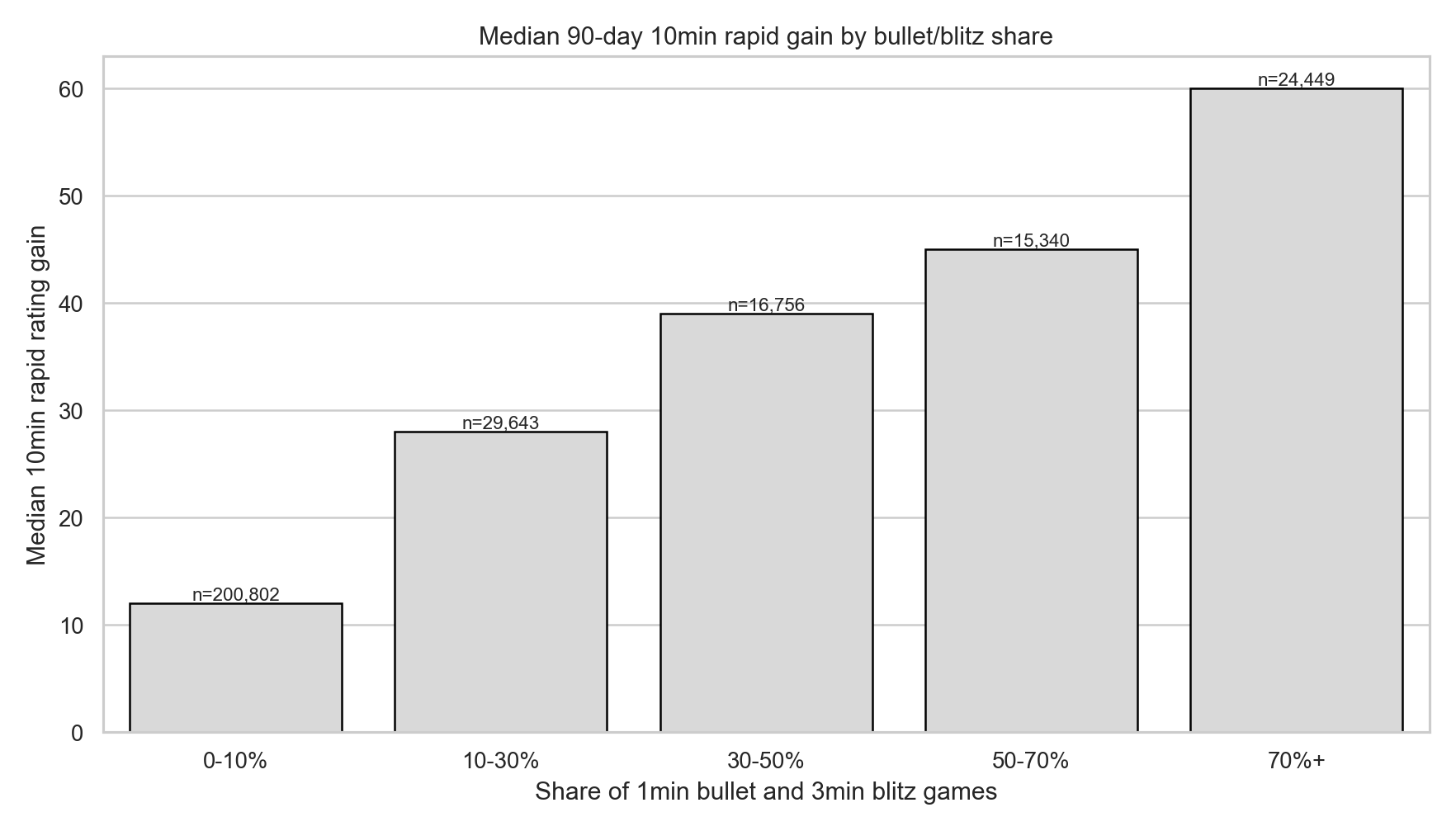
This is interesting, but it is not enough by itself. Fast-chess-heavy players may simply be more active chess players.
Could It Just Be That Fast-Chess Players Play More Chess?
This is the obvious criticism. Players who play a lot of 1min bullet and 3min blitz may simply be more engaged overall.
So we compared mostly-10min rapid players and heavy-bullet/blitz players within rough total-activity buckets:
| Total games | Mostly 10min rapid players | Mostly 10min rapid median | Heavy bullet/blitz players | Heavy bullet/blitz median |
|---|---|---|---|---|
| 0-50 | 39,361 | -15 | 632 | +15 |
| 50-100 | 55,426 | -4 | 3,149 | +26 |
| 100-250 | 70,411 | +16 | 6,973 | +42 |
| 250-500 | 40,585 | +42 | 6,207 | +66 |
| 500+ | 24,796 | +58 | 7,488 | +96 |
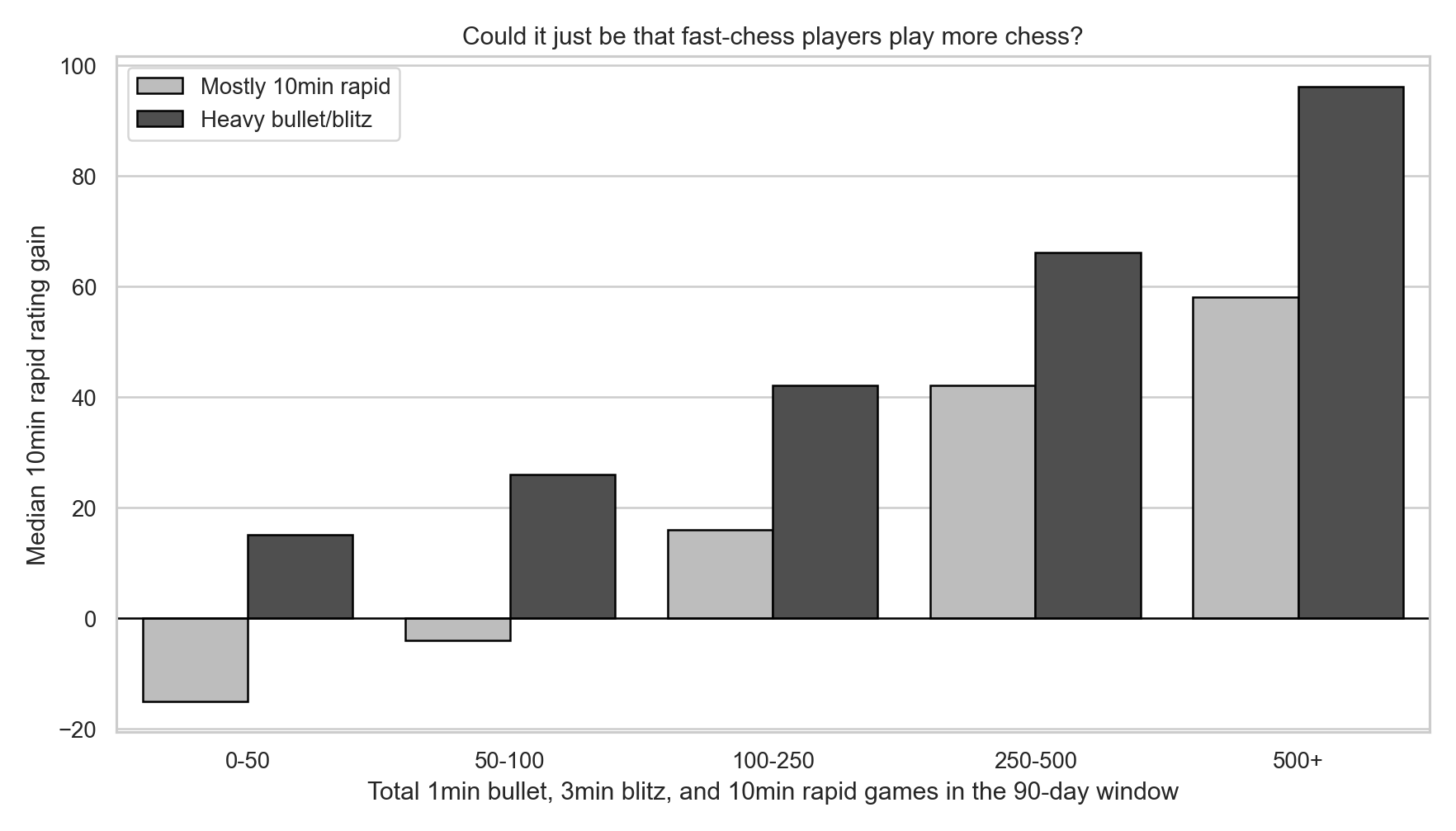
Within each total-games bucket, heavy bullet/blitz players still did not underperform in median 10min rapid gain.
What Happens After Controlling For What We Can Measure?
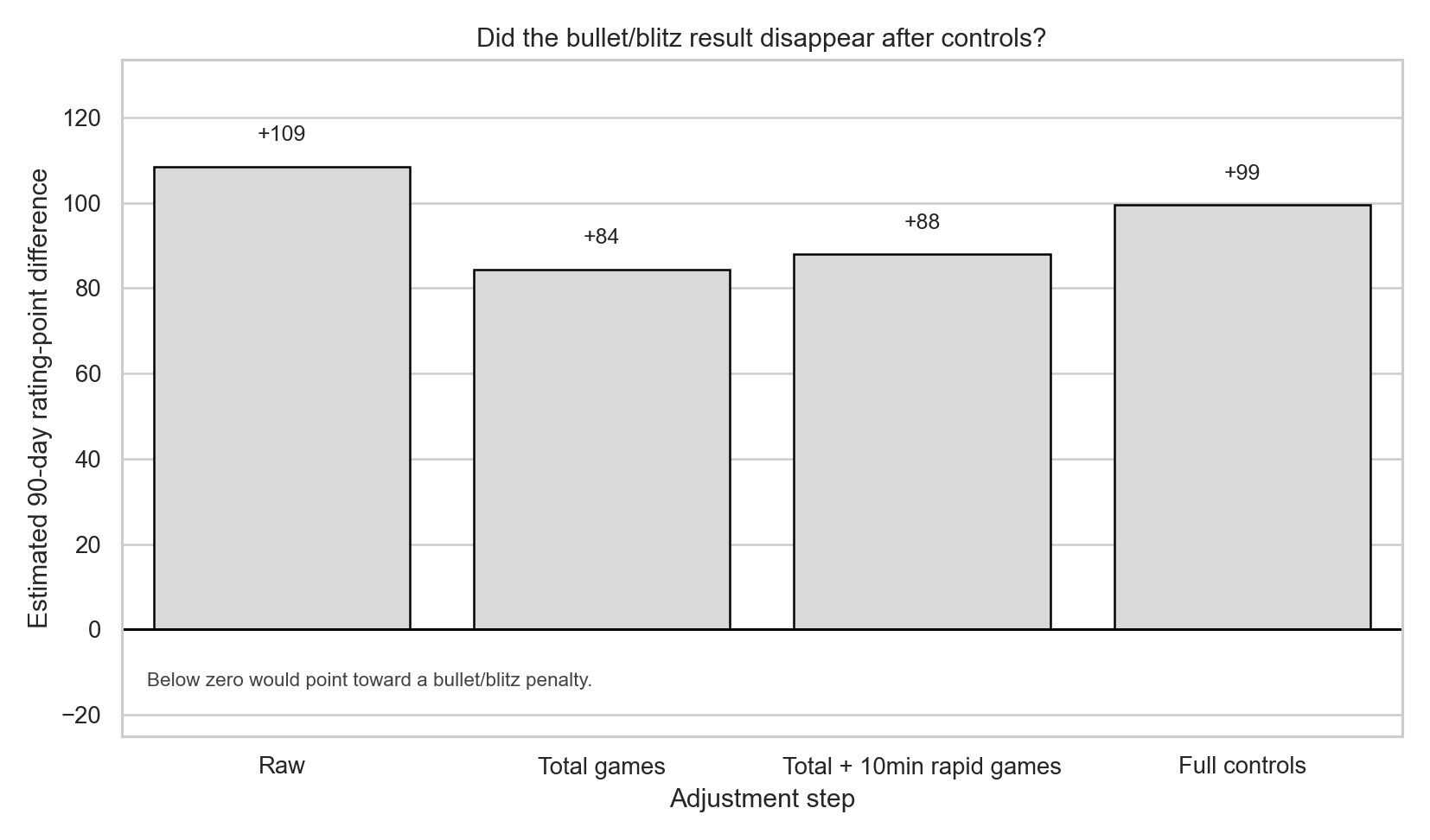
We also checked whether the fast-chess result disappeared after adding simple controls: total games, number of 10min rapid games, starting rating, and actual window length.
The estimate changed, but it did not become negative. This is not causal proof; it simply means the model did not reveal a broad 1min bullet / 3min blitz penalty.
What We Found
✓ The large Lichess.org sample gives tight estimates because every main bucket has thousands of eligible players.
✓ Fast-chess-heavy players did not consistently underperform at 10min rapid.
✓ We found no broad evidence that 1min bullet or 3min blitz damages 10min rapid improvement for 600-1400 starting-rating players.
? We still cannot determine whether bullet or blitz causes improvement.
? We still cannot observe study habits, coaching, puzzle work, opening preparation, or how seriously players reviewed their games.
Practical Takeaway
Do not read this as "play only bullet."
Read it as: do not panic if you enjoy 1min bullet and 3min blitz. In this much larger Lichess.org sample, mixing fast chess into your chess diet did not show a 10min rapid improvement penalty.
The practical advice is still balanced: play games where you think, review your mistakes, and use fast chess as one part of your chess life rather than your only training method.
Is This Robust?
Yes, in the sample-size sense. The Lichess.org sample has hundreds of thousands of eligible improvement windows, so random bucket noise is much less of a concern.
No, in the causal sense. This is still observational. Players choose their own time controls. Fast chess may be a marker for highly engaged players rather than a cause of improvement.
Technical Appendix
Study Funnel
- Starting pool: 1,382,178,087 public Lichess.org games
- Selected 1min bullet / 3min blitz / 10min rapid games before player-history filters: 798,089,279
- Study coverage: 2025-01-01 through 2026-03-31
- Candidate player histories: 1,861,652 players with a first observed 10min rapid rating between 600 and 1400
- Sampling method: mechanical inclusion from public game records, not a stratified sample
Sample Counts
- Player improvement windows: 5,584,956
- Enough-data player improvement windows: 768,324
- 90-day enough-data rows: 286,990
- Starting 10min rapid rating range: 600-1400
Eligibility Rules
For the main 90-day comparison, a player history had to satisfy all of the following:
- first observed 10min rapid rating between 600 and 1400
- at least 10 10min rapid games in the window
- at least 30 total games across 1min bullet, 3min blitz, and 10min rapid
- at least 60 days between the first and last 10min rapid rating observation in the window
- at least one 10min rapid game in the first 14 days of the window
- at least one 10min rapid game in the final 14 days ending at the player's last observed 10min rapid game in the window
Cohort Summary
| Group | Players | Median 90-day 10min rapid gain | Plain-English note |
|---|---|---|---|
| Mostly 10min rapid | 230,579 | +14 | At least 70% 10min rapid |
| Mixed | 31,962 | +42 | Neither heavily fast nor heavily 10min rapid |
| Heavy bullet/blitz | 24,449 | +60 | At least 70% 1min bullet / 3min blitz |
Regression Setup
The regression checks use the same main 90-day sample discussed above.
- Dependent variable: 90-day 10min rapid rating gain.
- Main variable of interest:
fast_chess_share = (1min bullet games + 3min blitz games) / (1min bullet + 3min blitz + 10min rapid games). - Method: ordinary least squares linear regression.
- Standard errors: HC3 robust standard errors.
- Interpretation: the
fast_chess_sharecoefficient estimates the association between moving from 0% fast chess to 100% fast chess, holding the included controls fixed. It is not a causal effect.
The total-games control is entered as log(1 + total games) because activity counts are highly skewed.
Readable model definitions:
- Raw:
rapid_gain_90d = beta0 + beta1 fast_chess_share + epsilon
- Total games:
rapid_gain_90d = beta0 + beta1 fast_chess_share + beta2 log_total_games + epsilon
- Total + rapid games:
rapid_gain_90d = beta0 + beta1 fast_chess_share + beta2 log_total_games + beta3 rapid_10min_games + epsilon
- Full controls:
rapid_gain_90d = beta0 + beta1 fast_chess_share + beta2 log_total_games + beta3 rapid_10min_games + beta4 starting_10min_rating + beta5 window_days + epsilon
Why Do All Models Use The Same Number Of Rows?
All four regressions are estimated on the same 286,990 eligible 90-day improvement windows. The row count stays the same because every included row has complete values for the controls used in the models. The sample is not changing; only the model specification is changing.
Regression Results
| Model | Controls included | Rows | fast_chess_share coefficient | Standard error | t-statistic | p-value | R-squared | Adjusted R-squared |
|---|---|---|---|---|---|---|---|---|
| Raw | None | 286,990 | 108.52 | 1.68 | 64.78 | < 1e-300 | 0.0147 | 0.0147 |
| Total games | log(1 + total games) | 286,990 | 84.33 | 1.66 | 50.82 | < 1e-300 | 0.0415 | 0.0415 |
| Total + 10min rapid games | log(1 + total games), 10min rapid games | 286,990 | 87.91 | 1.91 | 45.99 | < 1e-300 | 0.0415 | 0.0415 |
| Full controls | log(1 + total games), 10min rapid games, starting 10min rating, window days | 286,990 | 99.47 | 1.92 | 51.85 | < 1e-300 | 0.0949 | 0.0949 |
With a sample this large, very small effects can become statistically significant. The important question is not only whether the coefficient differs from zero, but whether it is large enough to matter and whether it changes sign after reasonable controls. In these models, the fast_chess_share estimate remains positive, so the regression checks did not reveal evidence of a broad bullet/blitz penalty.
Incremental R-squared From fast_chess_share
This estimates how much additional variation in 90-day rapid gain is explained by fast_chess_share after the other full-model controls are already included.
| Model | Rows | R-squared | Adjusted R-squared |
|---|---|---|---|
| Full model with fast_chess_share | 286,990 | 0.09487 | 0.094855 |
| Full model without fast_chess_share | 286,990 | 0.0864 | 0.086387 |
| Incremental R-squared from fast_chess_share | 286,990 | 0.00847 | 0.008467 |
Correlation Matrix
| Variable | 90-day rapid gain | fast_chess_share | total games | 10min rapid games | starting 10min rating | window days |
|---|---|---|---|---|---|---|
| 90-day rapid gain | 1 | 0.121 | 0.154 | 0.1 | -0.203 | 0.06 |
| fast_chess_share | 0.121 | 1 | 0.178 | -0.243 | 0.042 | -0.14 |
| total games | 0.154 | 0.178 | 1 | 0.767 | 0.099 | 0.177 |
| 10min rapid games | 0.1 | -0.243 | 0.767 | 1 | 0.083 | 0.243 |
| starting 10min rating | -0.203 | 0.042 | 0.099 | 0.083 | 1 | 0.015 |
| window days | 0.06 | -0.14 | 0.177 | 0.243 | 0.015 | 1 |
Multicollinearity Diagnostics
High VIF values indicate that predictors overlap strongly, which can make individual coefficient estimates less stable.
| Variable | VIF |
|---|---|
| fast_chess_share | 1.45 |
| log(1 + total games) | 2.85 |
| 10min rapid games | 2.84 |
| starting 10min rating | 1.02 |
| window days | 1.11 |
Caveats
- This is observational, not causal.
- Players self-select into time controls.
- The denominator intentionally focuses only on 1min bullet, 3min blitz, and 10min rapid for this first pass.
- This study uses rating histories and game counts, not move-by-move chess behavior.