Do Beginners Resign Too Early?
Not according to this dataset. Across ratings from under 800 to nearly 1800, players typically resign only after reaching roughly a 7-pawn engine disadvantage.
A Lichess 10+0 rapid study of the board state at resignation-like endings.
The Short Version
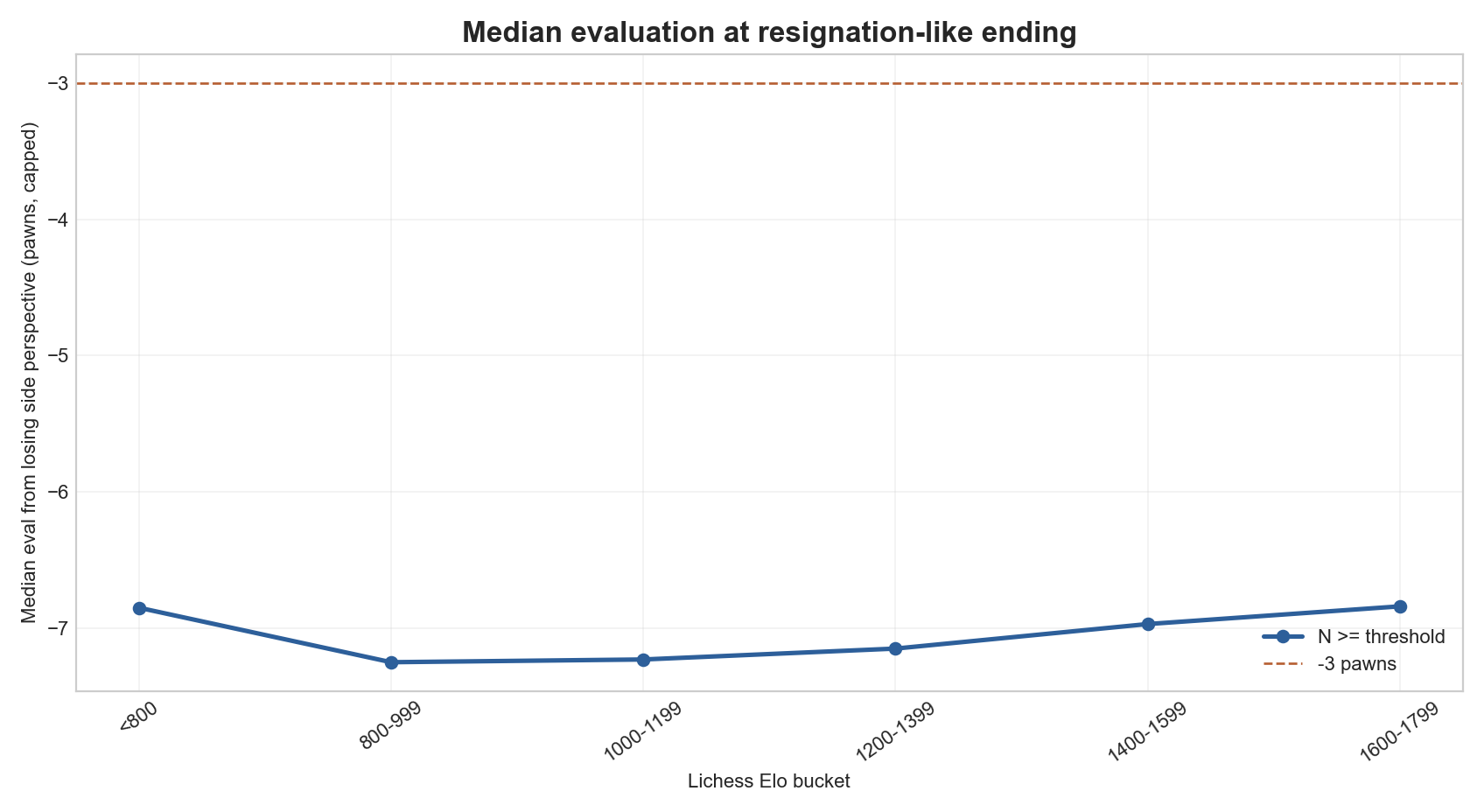
In this stratified Lichess rapid sample, resignation-like endings are usually not close positions. For rating bands with at least 1,000 examples, the median Stockfish evaluation from the losing side's perspective sits between -7.25 and -6.84 pawns.
This study conditions on games that ended in resignation-like outcomes. It does not include the much larger set of games where players were badly losing but continued. The results describe what resignation positions look like, not the probability of resigning from a given position.
How Severe Were The Positions?
The most common bucket was -5 to -8 pawns. Forced mate against the losing player was also common. Only about one in ten resignation-like endings occurred before the losing side was worse than -3 pawns.
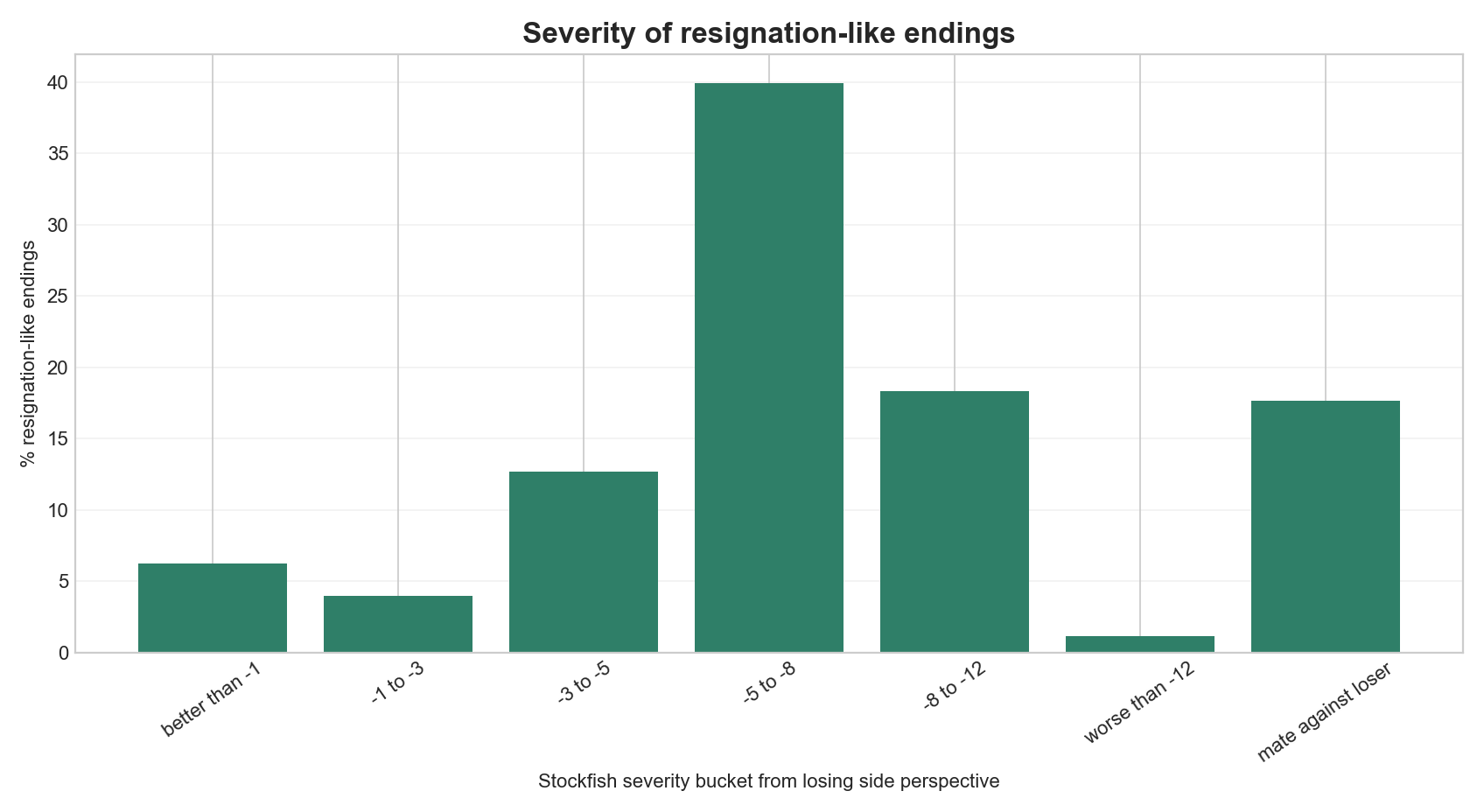
| Severity bucket | Rows | Share |
|---|---|---|
| better than -1 | 23,312 | 6.3% |
| -1 to -3 | 14,747 | 4.0% |
| -3 to -5 | 47,291 | 12.7% |
| -5 to -8 | 148,794 | 39.9% |
| -8 to -12 | 68,253 | 18.3% |
| worse than -12 | 4,264 | 1.1% |
| mate against loser | 65,886 | 17.7% |
Rating Bands
The well-sampled buckets below 1800 are strikingly stable. Lower-rated players are more likely to have a suspicious or close-to-equal ending, but the median resignation-like position is still heavily losing.
| Elo bucket | Rows | Median eval | Q1 | Q3 | % better than -3 | % suspicious | % plausible |
|---|---|---|---|---|---|---|---|
| <800 | 54,086 | -6.85 | -9.32 | -4.29 | 19.1% | 13.7% | 83.6% |
| 800-999 | 62,782 | -7.25 | -9.68 | -5.15 | 12.1% | 7.8% | 90.4% |
| 1000-1199 | 70,088 | -7.23 | -9.50 | -5.29 | 9.7% | 5.9% | 92.7% |
| 1200-1399 | 79,008 | -7.15 | -9.37 | -5.34 | 7.9% | 4.3% | 94.4% |
| 1400-1599 | 84,372 | -6.97 | -9.04 | -5.29 | 6.8% | 3.4% | 95.4% |
| 1600-1799 | 22,067 | -6.84 | -8.89 | -5.21 | 6.4% | 2.9% | 95.9% |
What Counts As Resignation-Like?
Lichess game metadata in this sample distinguishes some terminal cases directly, such as time forfeits, abandoned games, draws, and insufficient-material endings. Elo+Chess also reconstructs final board positions so exact checkmates can be separated from other decisive normal endings.
Here, resignation-like outcomes means the losing side of games classified as
normal_decisive_unknown: decisive games whose final position is not checkmate and whose ending
was not classified as time forfeit, abandonment, insufficient material, or draw. This is an operational proxy,
not a perfect resignation label.
| Game end type | Games | Losing-side rows | Share |
|---|---|---|---|
| normal_decisive_unknown | 372,547 | 372,547 | 48.3% |
| checkmate_on_board | 271,289 | 271,289 | 35.2% |
| time_forfeit | 92,930 | 90,336 | 12.0% |
| draw | 33,166 | 0 | 4.3% |
| abandoned | 1,293 | 1,293 | 0.2% |
| insufficient_material | 80 | 0 | 0.0% |
Stockfish Evaluation By Elo
Boxplots show the spread of capped engine evaluations at resignation-like endings. The chart keeps only well-sampled rating bands, which makes the visible comparison less noisy.

Suspicious Endings
Suspicious endings include cases where the losing side was close to equal, objectively better, or otherwise not clearly lost by the engine/material rules used in this prototype.

Material Deficit
Engine evaluation and material are not the same thing, but the material table points in the same direction: many resignation-like endings occur after the losing player is already down substantial material.
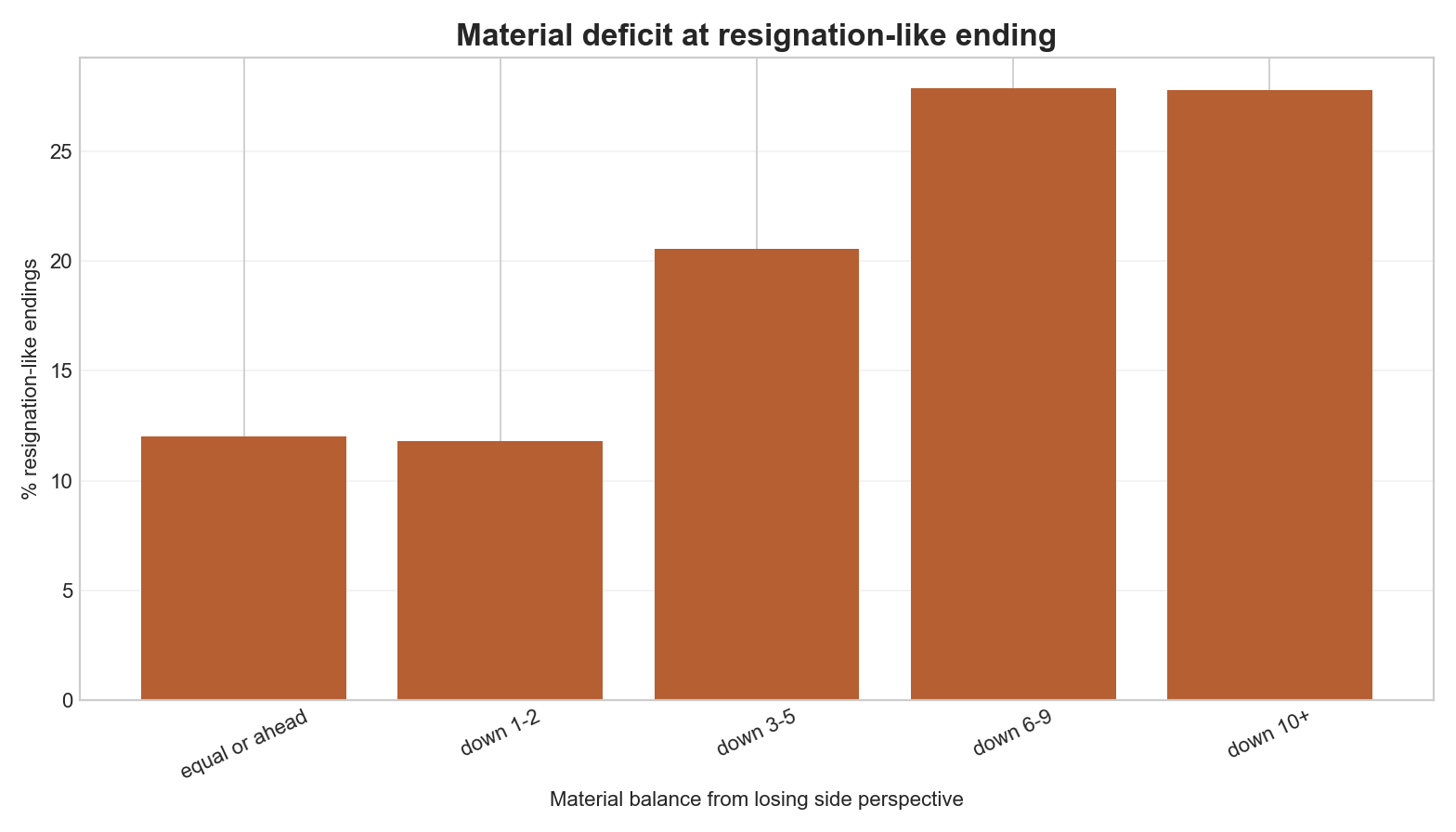
| Material deficit | Rows | Share |
|---|---|---|
| equal or ahead | 44,745 | 12.0% |
| down 1-2 | 43,928 | 11.8% |
| down 3-5 | 76,559 | 20.6% |
| down 6-9 | 103,836 | 27.9% |
| down 10+ | 103,479 | 27.8% |
What This Does And Does Not Show
Shows
- When games end in resignation-like outcomes, the losing side is usually already in a severe engine disadvantage.
- Suspicious or equal-position endings are a minority.
- Below 1800, median resignation severity is surprisingly stable.
Does not show
- The probability a player resigns at -3, -5, or -8.
- How often players continue from lost positions.
- Whether resignation was objectively correct.
- Practical human comeback chances.
Caveats
- This is a Lichess 10+0 rapid sample, not all chess players.
- Resignation metadata is imperfect;
normal_decisive_unknownis a practical proxy. - Fixed-time Stockfish evaluations are noisy.
- Engine evaluation is not the same as practical human hope.
- Conditioning only on resignation-like endings creates selection bias.
- Small high-Elo buckets were excluded from the charts and article claims.